


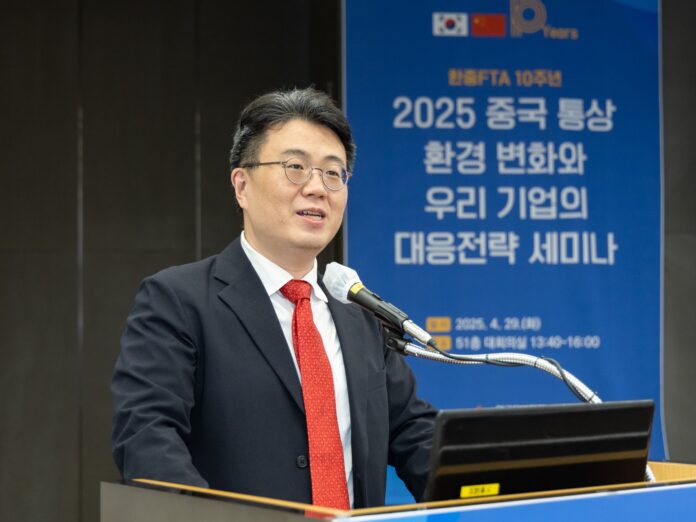
The Korea International Trade Association (KITA) FTA and Trade Comprehensive Support Center (Director: Vice Chairman Lee In-ho) held the '2025 China Trade Environment Changes and Response Strategy Seminar' at the Trade Tower in Samseong-dong, Gangnam-gu, Seoul on the 29th.
This seminar was organized to examine the changes in China’s trade environment and market trends due to the tariff measures of the Trump administration in its second term, and to seek response measures for our companies. With about 100 executives and staff from export and import companies in attendance, presentations were given on ▲the latest Chinese economic and market trends, ▲China’s foreign trade and investment policies, ▲major impacts and response strategies due to changes in the global trade environment, ▲Korea-China FTA and RCEP utilization strategies, etc.
Park Seung-chan, director of the China Management Research Institute, introduced the Chinese government’s policies of stimulating consumption, fostering cutting-edge industries, and technological independence to overcome domestic and external crises such as the US-China trade conflict and the domestic economic downturn, as well as promising industries due to the rise of new consumer classes such as the elderly population and gold misses. Kim Hyeon-jun, director of Samil PwC, analyzed the US’s reciprocal tariff imposition and the responses of major countries and emphasized that Korean companies should prepare for supply chain risks by adjusting transaction structures, changing production lines, establishing new corporations, and mergers and acquisitions (M&A).
Lim Geum-seon, a customs broker at the China Desk of the Korea International Trade Association, advised that Korea should use the most advantageous agreement for each product by comparing and reviewing the agreement tariff rates and country of origin determination criteria of trade agreements concluded between Korea and China, such as the Korea-China Free Trade Agreement (FTA), the Regional Comprehensive Economic Partnership (RCEP), and the Asia-Pacific Trade Agreement (APTA).
Won-Seok Joo, head of the FTA and Trade Comprehensive Support Center, said, “As the global tariff war has intensified recently, our companies are facing a double whammy of supply chain reorganization and increased tariff costs.” He added, “We need to devise various entry strategies in line with changes in the Chinese market and actively utilize trade agreements such as the Korea-China FTA when necessary.”
Meanwhile, the FTA and Trade Comprehensive Support Center China Desk, established in March 2015 to prepare for the implementation of the Korea-China FTA, celebrated its 10th anniversary this year. China Desk is evaluated to have contributed to increasing the utilization rate of the Korea-China FTA from 33.9% in 2016 to 83.1% in 2024 through over 60,000 corporate consulting cases over the past 10 years.
- See more related articles
You must be logged in to post a comment.