



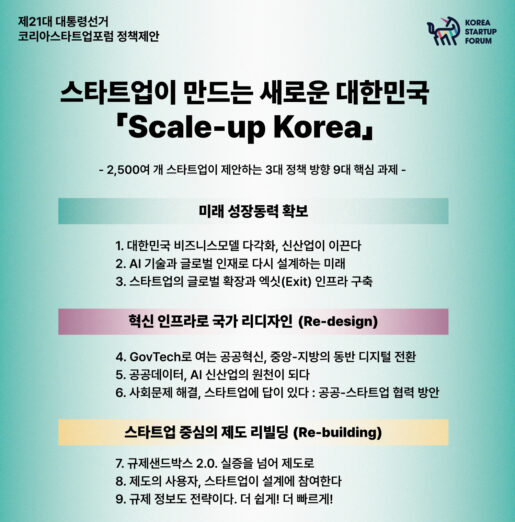
The Korea Startup Forum (Chairman Sang-Woo Han, hereinafter referred to as KOSPO) announced on the 24th that it has published ‘Scale-up Korea: A New Republic of Korea Created by Startups,’ a startup policy proposal for the next government ahead of the 2025 presidential election.
This proposal is the result of the work of the COSPO Policy TF, which was formed during the early presidential election process to make startups the core of the nation's future strategy. The policy TF was led by COSPO Foreign Policy Division Co-chairs Jeong Ji-eun, CEO of Codet, and Lee Hyeon-jae, CEO of Yes Future, and was widely participated by major member company entrepreneurs, startup ecosystem members, and experts. It is significant in that startups, both policy demanders and designers, actively participated in the policy, which is a practical policy proposal that goes beyond simple demands.
In this proposal, KOSPO defined startups as the central axis of solving social problems and technology-based industrial innovation, not simply as the subject of startups, and emphasized that the next government should actively utilize the private sector’s innovation capabilities to secure future growth engines. In particular, it made it clear that startups are strategic assets that can contribute to the national economy as a whole, such as diversifying business models, creating jobs, increasing tax revenue, and realizing social values, amid structural challenges such as global technology hegemony competition and changes in population structure.
This proposal goes beyond simple support measures and is an action-oriented strategy for Korea to leap forward as a country leading future industries. In particular, KOSPO emphasized that “the next government must boldly pursue reforms with the determination to ‘eliminate 100 regulations in 100 days,’ and precise and flexible regulatory innovations that keep pace with rapidly evolving technologies are essential.” It strongly raised the need for institutional practices to resolve innovations in the field that are blocked by outdated systems and to enable startups to grow in ‘a country that is actually good for starting a business.’
The first, 'Securing Future Growth Engines', included key tasks 1-3 such as ▲Diversification of South Korea's business models, led by new industries ▲Redesigning the future with AI technology and global talent ▲Global expansion of startups and establishment of exit infrastructure. The second, 'Redesigning the nation with innovative infrastructure', included key tasks 4-6 such as ▲Public innovation opened by GovTech, joint digital transformation of the central and local governments ▲Public data, the source of new AI industries ▲Solving social problems, the answer lies in startups: Public-startup cooperation plans. The third, 'Startup-centered institutional rebuilding', presented key tasks 7-9 such as ▲Regulatory Sandbox 2.0. Beyond verification to system ▲Users of the system, startups, participate in design ▲Regulatory information is also a strategy. Easier! Faster!
Jeong Ji-eun, Co-Chair of the Foreign Policy Division of COSP (CEO of CODIT), said, “Startups are the core players in diversifying national business models and the future of the Republic of Korea,” and “This proposal contains implementation-oriented reform directions, from regulatory improvement tasks that can be implemented quickly to policies that are subject to fast-tracking. In particular, the new government must create an institutional communication channel so that startups can properly convey their voices from the field from the policy and regulation design process.”
Han Sang-woo, chairman of KOSPO, emphasized, “KOSPO has continuously improved the institutional irrationality and regulatory contradictions that startups face,” and “I expect that this proposal will not only support startups’ securing global competitiveness and qualitative growth of new industries, but also contribute to building a digital transformation ecosystem that connects private technology and public innovation. Korea’s competitiveness depends on the innovation created by startups, and I hope that KOSPO will be at the starting point.”
Korea Startup Forum is the largest startup association in Korea, leading the joint growth of the startup ecosystem with approximately 2,500 member companies. It has been carrying out a wide range of activities, including improving the business environment for startups, proposing policies, and supporting global expansion. As of last year, the annual sales of KOSPO member companies amounted to approximately 20 trillion won, the number of employees was approximately 50,000, and the cumulative investment attracted amounted to approximately 33 trillion won, contributing to the creation of economic value. Based on the experience of reflecting policies in the 19th and 20th presidential elections, KOSPO plans to continuously present measures that can further advance the startup policy of the new government in the future.
- See more related articles
You must be logged in to post a comment.