



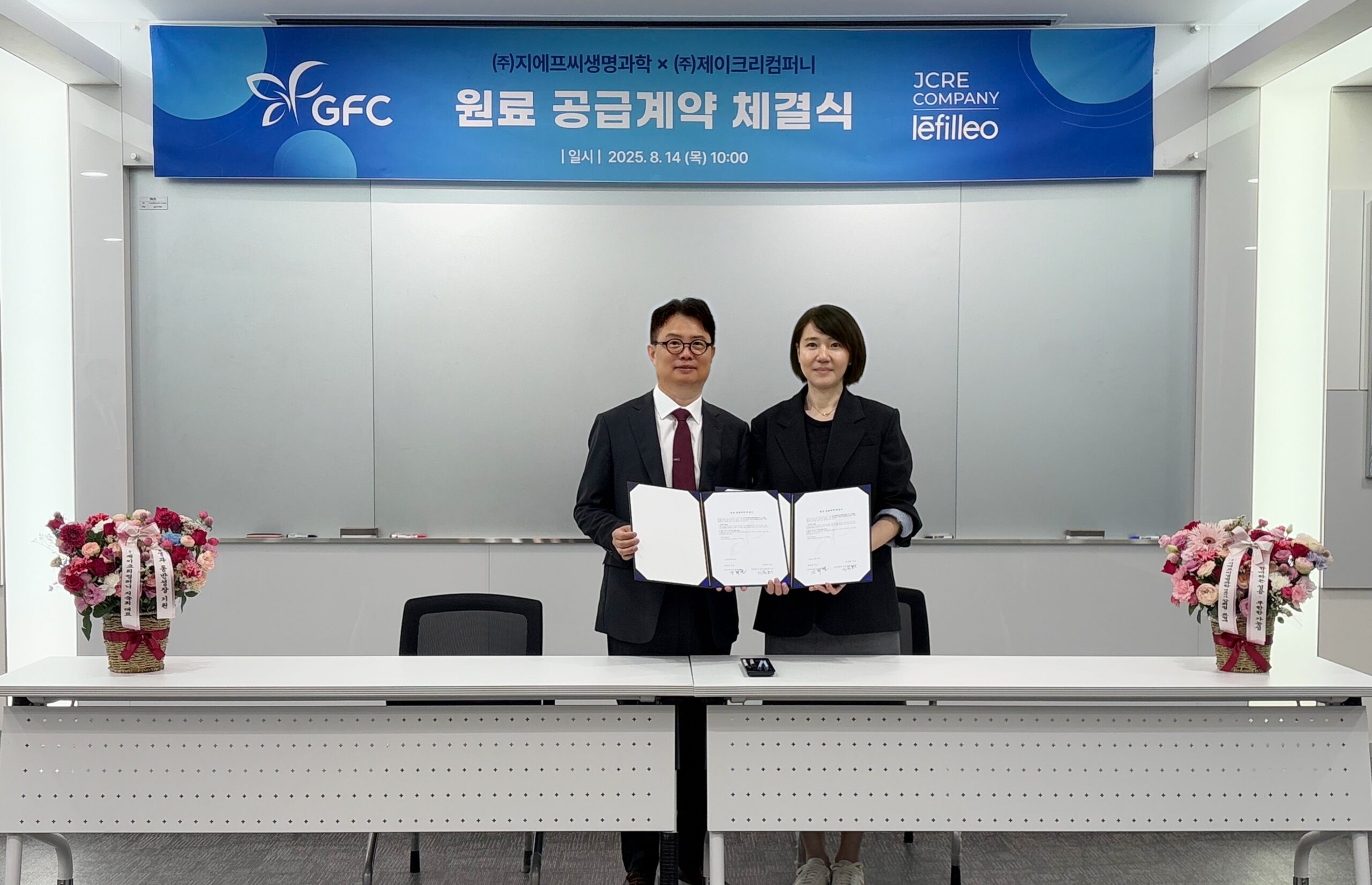
GFC Life Science (Co-CEOs Kang Hee-chul and Pyo Hyeong-bae), a bio-dermatology company, announced on the 14th that it has signed a strategic partnership with domestic premium skincare brand Jake Company (CEO Ji Sook-hee) and granted exclusive rights to use two types of high-function milk-derived exosome raw materials in Korea and China.
Through this agreement, GFC Life Science will stably supply high-purity exosomes 'Milk Exosomes Collagen Complex' and 'Milk-LipoExo' containing 'miRNA-2478', which has excellent whitening and skin regeneration efficacy. Jake Company plans to apply these to its core lineup, including the premium derma brand 'lēfilleo', to establish a new premium core line with whitening and skin regeneration efficacy. 'lēfilleo' has already increased its brand power in Korea, China, Russia, and Vietnam by expanding its filler and skincare lineup and as an official sponsor of Miss Korea.
“Through this collaboration, we will further expand the global market entry of advanced biomaterials and increase the value of our partner brands and consumer satisfaction,” said Kang Hee-chul, CEO of GFC Life Science. “Exosomes containing miRNA-2478 are a next-generation material that has been clinically proven to alleviate skin pigmentation and promote regeneration, and will be a game changer in the fields of improving skin tone, repairing damage, and anti-aging.”
While expanding its global network, GFC Life Sciences continues to strengthen its technological barriers by conducting research on plant cell-based exosomes. Recently, the company announced that it has demonstrated the mechanism by which miRNA167, a component within exosomes derived from the halophyte Crithmium maritimum L., exerts its effects on human skin. The paper, published in the Swiss SCI-level international academic journal Biomolecules,
The research team at GFC Life Science announced that when miRNA167, which exists in high concentrations in rock samphire exosomes (Cm-callus EVs), was applied to the skin, it promoted wound healing and skin regeneration. In addition, the expression of COL1A1 and VEGFA genes related to skin elasticity and collagen synthesis increased, and the MMP1 gene, which breaks down collagen, decreased. In particular, through in silico (computer simulation-based experiment) analysis, PPP3R2 was identified as a target gene of miRNA167, and it was suggested that this gene is involved in skin regeneration and inflammation control by being associated with the MAPK·NFAT signaling pathway.
GFC Life Science previously completed toxicity testing of camellia-derived exosomes through a GLP (Good Laboratory Practices)-certified institution, demonstrating their non-toxicity and non-irritating safety. Building on this success, GFC Life Science plans to simultaneously ensure human safety and environmental friendliness for all plant-derived exosomes, including Roxamphire exosomes, and strengthen its differentiated competitiveness in the global cosmetics and biotech markets.
CEO Kang Hee-chul said, “This study is an innovative achievement that further proves the concept of ‘cross-kingdom regulation’ that plant-derived miRNA can regulate human cell gene expression, following the previous study on miRNA408 in camellia-derived exosomes,” and added, “We will continue to increase our differentiated competitiveness in the global market as a next-generation biomaterial platform that is both environmentally friendly and safe for the human body.”
- See more related articles
You must be logged in to post a comment.